
St. Louis County Court Calendars Explained
The District Court calendar in St. Louis County comes from the Sixth Judicial District rather than a separate county-court setup. Calendar links are published for the Duluth, Hibbing, and Virginia facilities. Each location sits within the same Minnesota District Court. It offers full court-administration service.
A calendar line can show plenty. It lists the hearing location, date, time, judicial officer, hearing type, connection type, party name, and case number. It tells you what is set. It does not tell you what happened. And it is no substitute for the Register of Actions. Cases get assigned to a courtroom, a judge, or a remote session. So the case number plus the court location beats a party name alone. Confidential matters may never appear on a public calendar. Even a posted PDF can go stale. A scheduled line can change after it goes up.
St. Louis County Weekly Court Calendars
Weekly calendars for Duluth, Hibbing, and Virginia sit on the Sixth Judicial District calendar page. Each facility is linked separately. These are posted PDFs, not a free-text search form. Duluth court information says the public calendar appears at approximately 7:00 a.m. each business day. It also gets hourly updates. On hearing day, printed calendars outside courtrooms and in public lobbies can be fresher than the PDF.
The Sixth District county-calendar page also serves as the official reference for these postings.
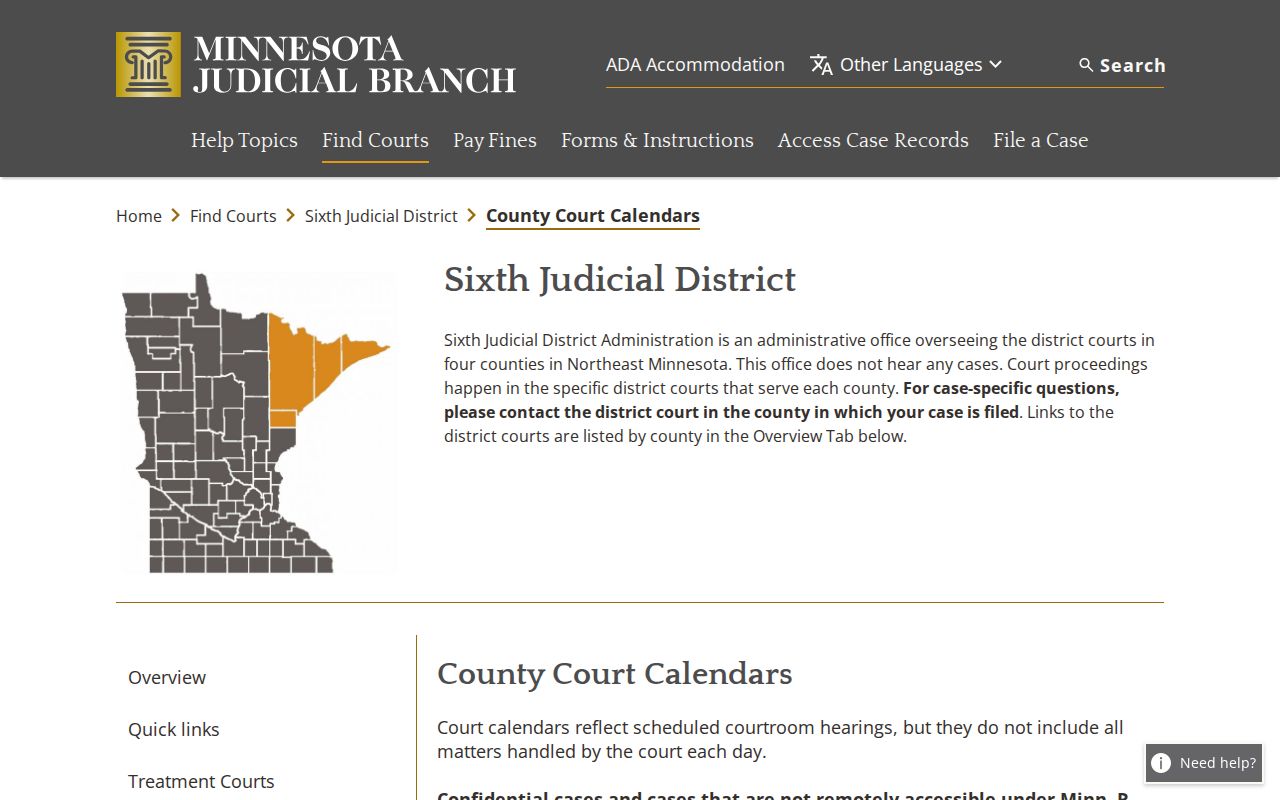
Each courthouse has its own calendar link. Match the assigned facility against the case number before trusting any St. Louis County court calendar row.
Finding Your Court Date
Confirm a court date through more than one channel, above all close to the hearing. Begin with a full case number in MCRO Case Search. Then check the facility calendar and the latest notice or order. MCRO Hearing Search is a separate, hearing-focused tool. It accepts a person or business name. It also takes a case number, a judicial officer, an attorney name, or an attorney bar number. Whatever the calendar says, match the entry to the case number before treating it as your setting.
If the online route comes up short or a same-day change looms, call court administration at the assigned facility. Duluth's main number is (218) 221-7560. Hibbing's is (218) 274-6007. Virginia's is (218) 305-7021. All three courthouses have public-record terminals. The printed calendar outside a courtroom may be the newest posting of all. Court administration can confirm logistics and the public record route, though it cannot give legal advice.
- Search MCRO by complete case number and note the court location, next event, and any hearing details.
- Open the current Duluth, Hibbing, or Virginia calendar PDF for the assigned facility.
- Compare the calendar row with the latest mailed, electronic, or hand-delivered court notice or order.
- Use MCRO Hearing Search when the task is locating a hearing rather than reviewing the entire case record.
- Call local court administration or check the public terminal and printed calendar if a day-of-hearing answer is needed.
Note: Cross-check any calendar row by case number. A party name alone may not point to the correct proceeding.
St. Louis County Hearing Search Options
MCRO offers four public functions: Case Search, Document Search, Hearing Search, and Judgment Search. For a court date, Hearing Search and the weekly facility calendar do the narrow work. Hearing Search finds an upcoming or recorded setting. You can search by person or business, case number, judicial officer, attorney name, or complete bar number. Case Details then layers on the Register of Actions, documents, and other public case context.
Do not treat Calendar Search and Hearing Search as the same tool. The calendar PDF covers one facility for one period. Hearing Search is an MCRO function. A hit in one does not promise matching detail in the other. Calendars change. A case can hold public events that a given calendar output never shows. A live scheduling question still deserves the latest court notice. It also deserves a call to the courthouse.
The Minnesota Judicial Branch release-notification page tracks system updates that shape these tools.
System releases can change how the interface behaves and how events are handled. One more reason to check a current court calendar instead of saving it as case history.
How to Read a Court Setting
A calendar row packs in several scheduling facts. The hearing location may be a courtroom, a facility, or "Remote Hearing." When listed, the judicial officer names the judge or referee assigned to that entry. The hearing type names the planned proceeding. Arraignment, motion, plea, sentencing, review, evidentiary hearing, scheduling conference, court trial, probate, and order-to-show-cause hearing all appear here. Treat the row as a planning aid. It is not a final order.
| Party name | The listed participant. Confirm with the case number rather than relying on a name alone. |
|---|---|
| Hearing location | Room, facility, or remote-hearing location. The room or connection method can change. |
| Date and time | The scheduled setting, not proof that the hearing occurred. |
| Judicial officer | The judge or referee identified for that calendar line when supplied. |
| Hearing type | The planned matter, such as a motion, arraignment, trial, plea, or sentencing. |
| Connection type | A scheduled participant connection label, not a case outcome. |
| Case number | The exact identifier to cross-check in MCRO and with court administration. |
St. Louis County Calendar Row Details
St. Louis County's court calendar blends record fields with logistics fields. The hearing type signals what kind of court event is planned. The connection type identifies who is scheduled. The list runs through Defendant, Attorney, Petitioner, Respondent, Plaintiff, Tribal Representative, or another listed connection. None of those labels say whether the person appeared. They do not say whether the court ruled or whether the case ended. For what actually happened, turn to the Register of Actions and the later order.
- Setting
- A scheduled court event with a date, time, location, and hearing type.
- Continuance
- A postponement moving a setting to a later date.
- Remote hearing
- A listed location or connection mode, not a statement of the result.
- Order to show cause
- A hearing label that should be read with the specific case record and notice.
- Register of Actions
- The chronological court event list that provides the broader case history.
A calendar row is only a starting point. Pull the case number from it and run that number through St. Louis County Case Lookup for the fuller docket picture. Then check the result against the court notice you already have, since the notice reflects the most current scheduling from the clerk.
Continuances, Resets, and Cancellations
St. Louis County publishes no local manual of reset codes. Nor does it list a coordinator line for every calendar. So label a continuance, reset, or cancellation carefully. Do it only when the Register of Actions, a notice, or an order actually says so. An old setting can sit in the chronological register. It stays there even after the newest date lands on the current calendar. And a missing row proves nothing about a hearing being canceled or a case ending. Work the sequence in order. Start with a case-number search in MCRO, then the current Sixth District calendar PDF, the latest notice or order, then local court administration. On a hearing day, the printed calendar outside the courtroom may beat them all for freshness. Times, rooms, judicial officers, and connection methods can all shift as the schedule develops.
St. Louis County Remote Hearing Labels
A "Remote Hearing" label sets the mode. It says nothing about the outcome. The Minnesota Judicial Branch adopted a district-court hearing framework in 2024. New default hearing modes took effect February 3, 2025. Judges can deviate when a case or participant calls for something different. So a remote or in-person tag on an older calendar is not a permanent instruction.
One more wrinkle: the Sixth District calendar page lists a recurring Tuesday public Zoom test session, running 8:30 a.m. to 1:00 p.m. Treat that operational detail as changeable. For any single hearing, the current notice, current calendar, and court-administration instructions govern. Connection details tell a party how to appear, never anything about the merits.
If You Miss a Court Setting
Move fast after a missed setting. Start with the case number. Check MCRO and the current calendar. Then call the assigned St. Louis County court-administration office for current public scheduling information. A court notice, an order, or an attorney can add case-specific direction. Assume nothing: the old date may no longer count, and a gap on the calendar does not resolve the matter.
Missed-setting warning: Missing a required court date can lead to serious consequences in a criminal or traffic matter, including a warrant or bond issue. Contact the court administration office or a licensed attorney promptly and follow the current court instructions for the specific case.
The Minnesota Rule 9 appeal page is the source for the image below.
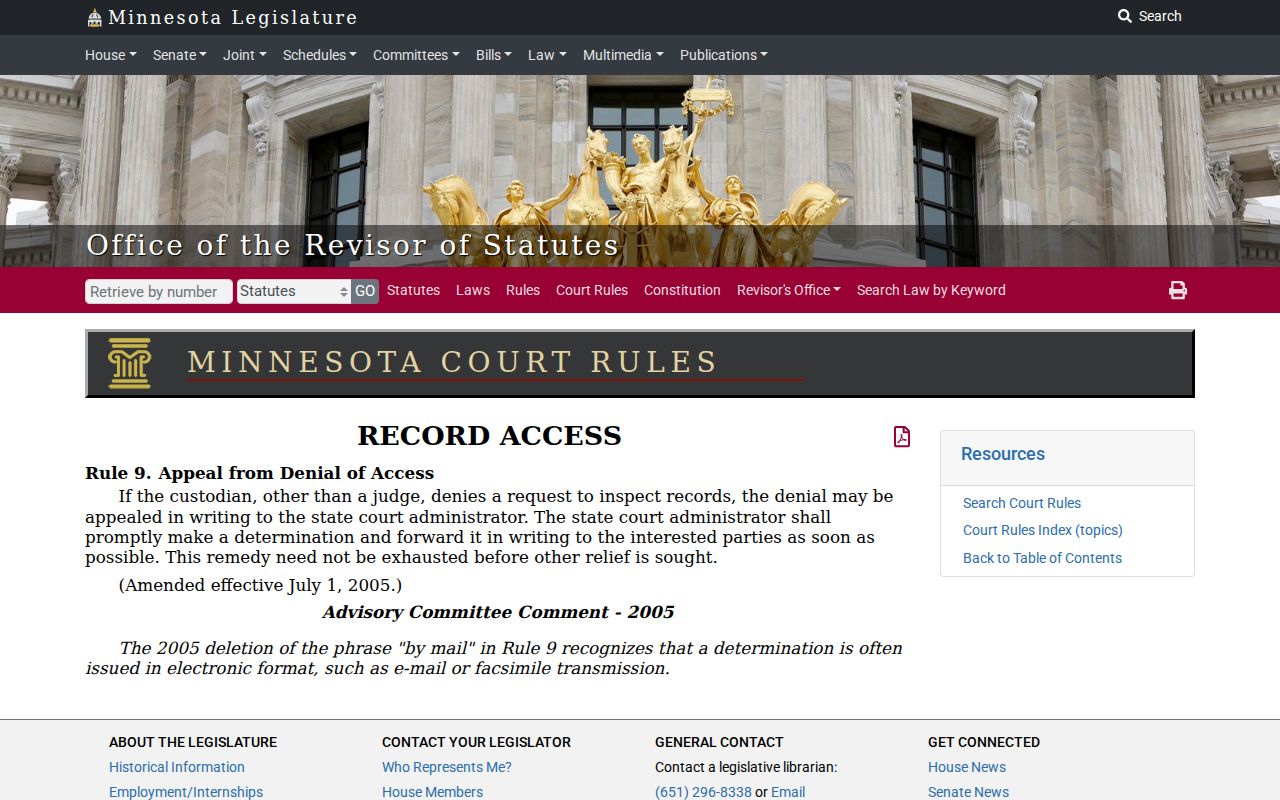
Rule 9 handles one specific thing. It covers a written appeal after a non-judge records custodian denies access to a court record. That is separate from any request to move a hearing date, though it sits within the same county public-record access framework.
St. Louis County Court Calendar Limits
Think of a calendar as a scheduling aid, nothing more. It is not a certified court record and not a full case history. A planned hearing may show up there. Not every filing, order, or outcome appears beside it. Flip it around, too: an empty calendar entry does not mean a case is absent, dismissed, confidential, or finished. Protected matters may stay off entirely. The weekly PDF may simply not cover a different date or facility.
For chronological case events, the Register of Actions is the better public source. For what the court actually directed, a filed order carries more weight. Need a certified copy? Request it through court administration or the Sixth District Copy Center. A publicly posted calendar PDF replaces neither record.
St. Louis County Day-of-Hearing Changes
For a live scheduling question, trust the newest source. Duluth calendar guidance warns that public calendars can update hourly. The official pages note that hearings can change. Check the current PDF close to the hearing day. If a time, room, connection method, or status still needs confirmation, call the facility or court administration. When remote information lags, the courthouse public terminal and the posted printed calendars still work well as public channels.
Each courthouse page posts its address and access details. Duluth District Court lists 100 N. Fifth Avenue W., Duluth, MN 55802. Hibbing lists 1810 E. 12th Avenue, Hibbing, MN 55746. Virginia lists 300 South Fifth Avenue, Virginia, MN 55792. Every page describes public court-record access and the same weekday office-hours window. These details route a person to the proper administration office, not to a separate county clerk.
Note: A current calendar plus direct court-administration confirmation beats a saved calendar PDF from an earlier time.
St. Louis County Calendar Record Checks
The calendar, MCRO, and the court notice each do a different job. The current PDF finds a setting. MCRO Case Details places that setting among the filings, orders, and other events in the docket. The latest notice or order gives the most direct record of what was scheduled or changed for a party. Compare all three. That habit prevents a common error. It stops you from treating a courtroom listing as the final word on a case.
When a public record is not available remotely, use the Duluth, Hibbing, or Virginia public-access terminal. Or ask the court-administration custodian about inspection and copies. Rule 7 allows oral or written requests that reasonably identify the record. A good request names the complete case number. It should also give the setting date, the facility, and the document or calendar information sought. Court administration can explain access logistics, but it cannot interpret the legal consequences of a setting.
St. Louis County Treatment Court Calendars
The Sixth Judicial District runs eight treatment courts. North St. Louis County hosts Hybrid and Mental Health programs, while the south side of the county offers Drug, Veterans, DWI, and Mental Health tracks. Each underlying case stays in District Court, so the county court docket for that case remains the record of note. An MCRO register can list qualifying case events. Treatment plans, assessments, medical information, compliance details, and participant-support records may be limited or confidential. A specialty calendar is never a full treatment history. The Sixth District Treatment Courts page lays out how the programs are organized.
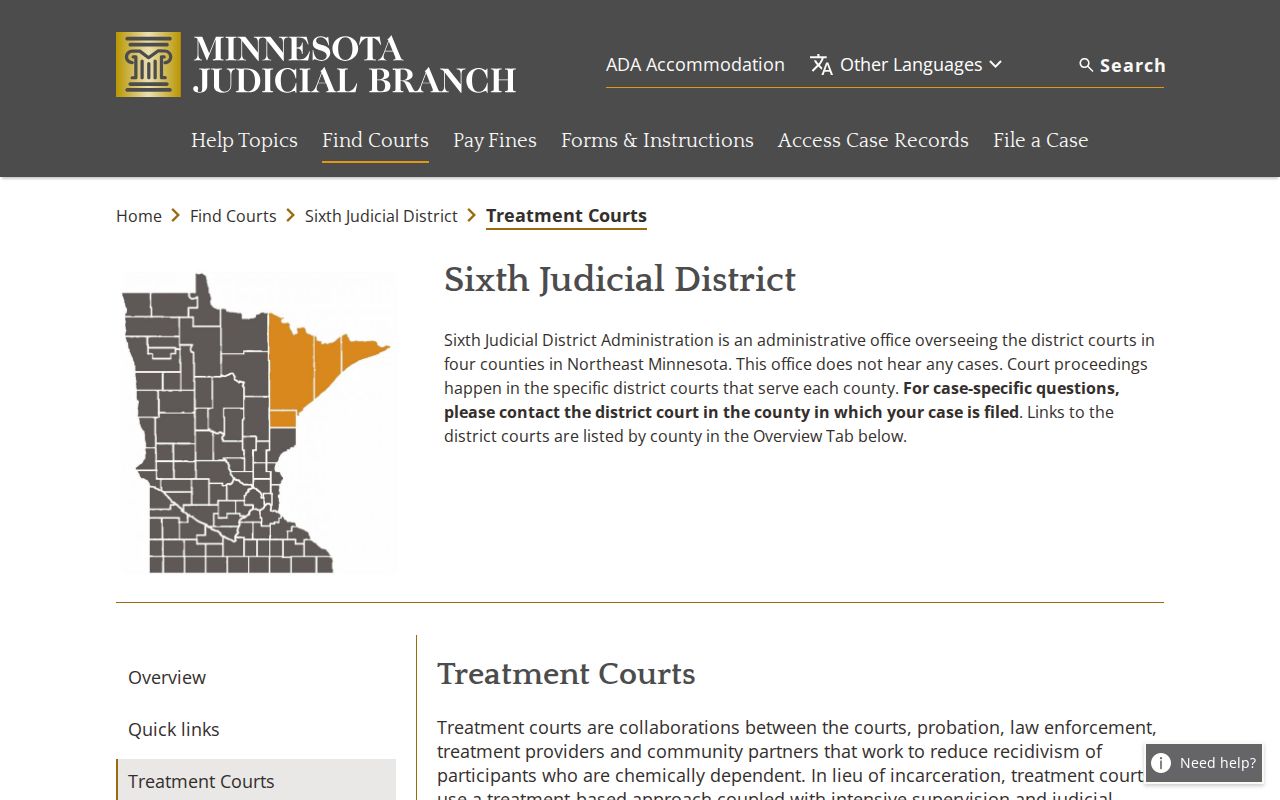
That program page covers general structure and contacts. For access to a specific public case event, court administration is the right office to ask.